

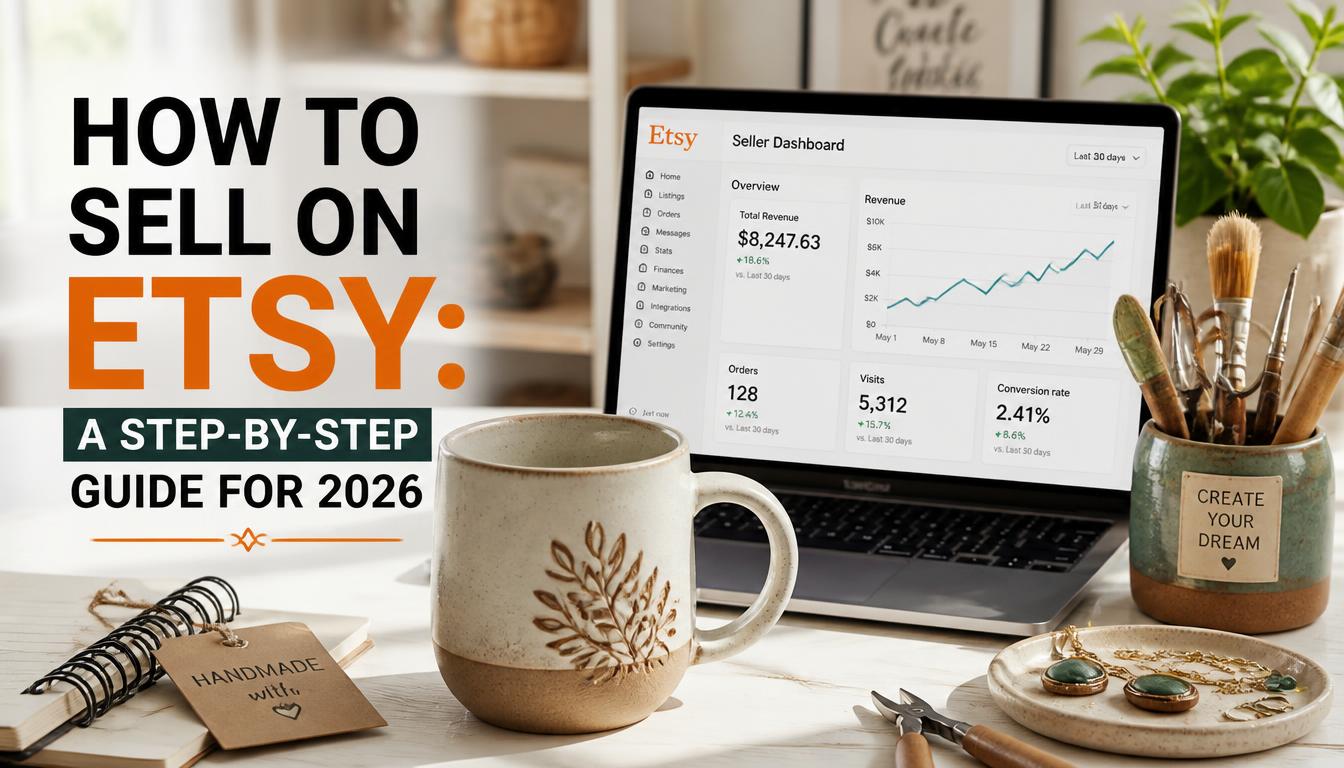
Etsy sellers generated an incredible $11.92 billion in sales in 2025 alone. That’s huge! 🤔
The thought of opening an Etsy shop can feel daunting. You need to set up your store, create listings, take photos, and handle orders. Many creative entrepreneurs feel overwhelmed and stuck at the very beginning.
The reality is that selling on Etsy can be straightforward and manageable. Your creative passion—whether it’s handmade jewelry, digital prints, or vintage treasures—can become a thriving online business. We’ll show you how.
Millions of successful Etsy sellers started right where you are today. This guide will walk you through each step to launch and grow your Etsy shop in 2026. You’ll learn everything from the original setup to marketing strategies that deliver results. Let’s begin!
Understanding Etsy’s Marketplace
Let’s start creating our Etsy shop by understanding what makes this marketplace special and how we can utilize its unique features for our success.
What Makes Etsy Unique
We’re joining a marketplace that’s entirely different from Amazon or eBay. Etsy’s mission to “keep commerce human” makes it stand out. The platform focuses specifically on handmade, vintage, and craft supplies. The best part about Etsy is its support for independent creators like us. It boasts a thriving community connecting 93.54 million active buyers with 8.76 million active sellers.
Types of Products That Sell Well
My research shows six main categories dominate Etsy’s sales. These categories account for 87% of all transactions:
- Home & Living: Highest sales volume.
- Jewelry & Accessories: Second most popular.
- Apparel: Growing steadily.
- Craft Supplies: Strong consistent demand.
- Paper & Party Supplies: Popular for celebrations.
- Toys & Games: A rising category.
Identifying Your Target Customer
Your success on Etsy depends heavily on understanding your target customer. The platform’s demographics show interesting patterns that will help position our products:
- Primary age group: Almost two-thirds of Etsy’s visitors are between 18 and 44 years old.
- Gender distribution: About 58.38% of Etsy’s visitors are female, while 41.62% are male.
- Shopping behavior: Over 70% of purchases are for special events, gifts, and personal use.
The sort of thing I love about Etsy is its growing buyer diversity. Our most valuable market segment consists of customers who buy six or more times annually and spend over $200. These marketplace dynamics help us position our shop better. Success comes from lining up our products and marketing strategies with Etsy’s unique ecosystem and customer expectations.
Setting Up Your Etsy Shop
Ready to dive into Etsy selling? Let’s get your shop up and running! Here’s a step-by-step walkthrough to help you start your journey.
Creating Your Seller Account
Your path to becoming an Etsy entrepreneur starts with a seller account. My experience helping countless sellers has shown these simple steps work best:
- Visit Etsy.com/sell to begin.
- Create your Etsy account or sign in.
- Complete identity verification (you’ll need a government ID and clear selfie).
- Set your shop country and currency.
- Add your profile picture and bio.
Choosing the Perfect Shop Name
Your shop name builds your brand identity on Etsy. I remember spending days picking my first shop name. These tips will help you choose wisely:
- Keep it under 20 characters (Etsy requirement).
- Avoid spaces and punctuation.
- Make it memorable and easy to spell.
- Check that it’s not already trademarked.
- Leave room to grow (don’t box yourself into just one product type).
Pro Tip: Stuck on ideas? Mix your name with words like “studio,” “designs,” or “crafts.” Something like “JaneStudio” or “CraftsByAlex” works great.
Setting Up Payment Methods
Money matters need careful attention. A proper payment setup makes your selling journey smooth. Start with these basics:
Connect your bank account to Etsy Payments—their built-in payment system. Your customers can then pay through:
- Credit cards
- Debit cards
- PayPal
- Etsy gift cards
- Apple Pay
- Google Pay
You’ll need a credit or debit card to cover your Etsy fees. The platform charges a one-time shop setup fee of $0.20 per listing and takes transaction fees from your sales.
Important: Double-check your bank details—Etsy puts a 5-day security hold on new or changed banking information. This small step saves you from payment headaches later.
Crafting Winning Product Listings
The real magic in your Etsy experience happens when you create product listings that sell. My experience shows that a good listing can turn casual browsers into loyal buyers. Let me share how you can make every part of your listings work better.
Writing SEO-Optimized Titles
My early days on Etsy taught me a lesson—clever, artistic titles don’t help with searches. Your title needs to work for both search engines and human readers. Here’s what works best:
- Put main keywords first.
- Write phrases exactly as buyers search for them.
- Stay within 140 characters.
- Make it easy to read.
- Add crucial details like size, color, or material.
Pro Tip: Put yourself in your buyer’s shoes. I always ask, “What would someone actually type to find this item?”
Creating Compelling Descriptions
The best descriptions follow what I call the “inverted pyramid” style. This structure helps me organize information that gets results:
- Opening: Key features and emotional benefits.
- Middle: Detailed specifications (size, materials, care instructions).
- Bottom: Shipping and return policies.
Starting with the most important details grabs your buyer’s attention right away. The content should sound natural while using your keywords—nobody wants to read something that sounds like a robot wrote it!
Maximizing Product Tags
Product tags are your hidden advantage for Etsy SEO. Each listing should use all 13 available tags—this gives your product 13 different ways to be found! Here’s what works for me:
- Choose multi-word phrases (they work better than single words).
- Make tags match your title words.
- Add synonyms and regional terms.
- Include occasions and specific uses.
- Add seasonal options.
Important: Each tag should be unique. Repeating words wastes your SEO opportunities. Your tags should target different search terms instead.
Mastering Product Photography
Bad photos can tank your Etsy shop—I learned this lesson the hard way when I first started selling. After countless photo shoots and years of practice, I’ve created a simple system that works for anyone just starting out.
Essential Equipment for Beginners
At first, I thought I needed fancy equipment for my Etsy shop. Now I know better. Here’s what you really need to take great product photos:
- Camera: A smartphone with a good camera.
- Lighting: Natural window light (provides even illumination).
- Background: A white foam board for a clean presentation.
- Tripod: A basic phone/camera stand for sharp, blur-free images.
Pro Tip: Natural light from a window during mid-day works just as well as expensive studio lights for beginners.
Photo Composition Tips
My photos improved dramatically once I figured out the right composition techniques. These simple tips took my product photography from amateur to professional:
- The rule of thirds works wonders—put products at intersection points.
- Different angles tell the whole story—take at least 5-7 views.
- Clean, consistent backgrounds boost your brand’s image.
- Product details matter—showcase unique features clearly in close-ups.
Editing Photos for Etsy
Photo editing seemed daunting at first. I’ve boiled it down to these simple steps that work every time:
- Adjust white balance to get colors right.
- Fine-tune exposure and brightness.
- Crop images to Etsy’s recommended 2000×2000 pixels.
- Remove distracting elements in the background.
- Save in high-quality JPEG format.
My biggest photography lesson was realizing that consistency matters more than perfection. Using the same lighting, background, and editing style across all listings creates a professional shop that attracts customers naturally.
Pricing Strategies for Success
Pricing products correctly stands as a vital decision we make as Etsy sellers. My experience helping hundreds of beginners start their Etsy experience has taught me that pricing can determine your shop’s success or failure.
Calculating Costs and Margins
My early days on Etsy taught me a hard lesson about underpricing products. These days, I use a detailed cost-tracking system that covers:
- Direct Costs: Materials, packaging, shipping supplies.
- Labor Costs: Your time, hired help.
- Operating Costs: Etsy fees, marketing, software tools.
- Overhead: Studio space, equipment depreciation.
A spreadsheet or accounting software helps track these expenses and gives a full picture of actual costs. Note that you must factor in your time—this goes way beyond just materials!
Competitive Pricing Research
Market research plays a key role before I finalize my prices. Here’s my tested approach:
- Study similar products in your niche (analyze 10-15 competitors).
- Note price ranges for comparable quality items.
- Think over your unique value proposition.
- Factor in shipping costs and policies.
Pro Tip: I’ve found that the lowest price isn’t always the best strategy. Quality handmade items often sell better at higher price points because price implies quality.
Setting Profitable Prices
Years of testing have led me to a reliable formula: Cost of Goods + Operating Expenses + Desired Profit Margin = Retail Price. Most Etsy beginners should target a profit margin between 20-50%.
Tiered pricing has worked wonders in my shop. I offer similar products at different price points. A jewelry seller might have simple, premium, and luxury versions of their designs. This lets customers choose based on their budget while maximizing profits.
Optimizing Your Shop for Search
Your success on Etsy depends on getting your products in front of the right buyers. I’ve become skilled at Etsy search optimization over the last several years, and these game-changing strategies are the sort of thing I love to share.
Etsy SEO Fundamentals
The Etsy search algorithm works in two main phases: query matching and ranking. A buyer’s search triggers Etsy to look for relevant listings by exploring:
- Title Keywords: High priority.
- Tags: Essential matching.
- Categories: Shop classification.
- Attributes: Product specifics (color, material, occasion).
Pro Tip: My visibility improved dramatically when I focused on relevancy instead of just high keyword volume.
Keyword Research Tips
My reliable system for finding perfect keywords came through trial and error. Here’s what works best:
- Study your Etsy Analytics to identify converting search terms.
- Use Etsy’s search bar suggestions for popular phrases.
- Monitor seasonal trends and adjust accordingly.
- Research competitor listings (but never copy them directly).
- Test different keyword combinations and track the results.
Improving Shop Rankings
The Etsy algorithm looks at several quality factors beyond just keywords. My shop’s visibility improved substantially when I focused on:
- Customer Service Excellence: Quick response times, prompt issue resolution, and high review ratings.
- Listing Quality: Effective use of all 13 tags, clear descriptions, and regular listing updates.
My shop really took off after I offered competitive shipping prices. SEO on Etsy needs constant attention. Monthly reviews and updates of listings based on performance data help maintain strong search rankings and steady sales growth.
Marketing Your Etsy Store
My Etsy shop’s sales grew from a steady trickle to a flowing stream of orders with effective marketing. Years of testing different marketing channels helped me find what actually brings traffic and sales.
Social Media Promotion
Each social media platform plays a unique role in our marketing toolkit. Here’s how I use the top platforms:
- Instagram: Best for visual storytelling (Product photos, behind-the-scenes).
- Pinterest: Best for long-term traffic (Product pins, DIY guides).
- Facebook: Best for community building (Shop updates, live videos).
My shop took off when I made my visuals consistent across platforms.
Email Marketing Basics
Email marketing became my most reliable way to make sales. My subscriber list grew faster than I expected once I started collecting email addresses. This approach works well:
- Give a good incentive (like a first-purchase discount).
- Put signup links in order confirmation emails.
- Add newsletter signup options to your shop’s About section.
- Send regular updates about new products and promotions.
Cross-Promotion Strategies
My shop grew faster when I worked with other Etsy sellers. Through shared marketing efforts, I found several approaches that work:
- Team Up for Sales Events: Partner with complementary shops, create themed collection launches, and share marketing costs.
- Create Bundle Deals: Combine products with other sellers, offer exclusive package pricing, and share customer bases.
Etsy’s analytics help track marketing results. Weekly stats show which channels bring the most traffic and sales, so I can adjust my strategy based on real data.
Managing Customer Service
Quality customer service is the lifeblood of any successful Etsy business. My experience selling has taught me that customer treatment directly affects our shop’s success and visibility in search results.
Setting Response Time Goals
Quick response times substantially improve shop rankings. The Etsy algorithm rewards shops that meet their customer service standards consistently.
- Initial Messages: Within 24 hours (High search visibility).
- Order Updates: Same day (Better reviews).
- Issue Resolution: Within 48 hours (Reduced cases).
Pro Tip: The Etsy Seller app helps me respond quickly, even away from my computer. This approach has helped me maintain a 95% response rate within 24 hours.
Handling Customer Questions
Customer questions need effective management. My system helps maintain quality communication while saving time:
- Quick Acknowledgment: Send an immediate response confirming receipt.
- Use Saved Replies: Create a library for common questions to save time.
- Detailed Follow-up: Provide complete information and include relevant shop policies.
Dealing with Issues
A proactive approach works best with problems. Address concerns immediately and professionally, take responsibility when appropriate, offer clear solutions with specific timelines, and always follow up after resolution. Successfully resolved problems often create loyal customers who bring repeat business.
Conclusion
A successful Etsy shop demands attention to several key elements. My journey taught me how proper setup, optimized listings, professional photos, and smart pricing create the perfect foundation. These components work together seamlessly to build a thriving online store.
Your shop’s visibility and growth depend on effective SEO and marketing strategies. Building authentic customer relationships proved invaluable. Quick responses and professional problem-solving helped my Etsy business flourish consistently.
Success on Etsy takes time. You should implement these strategies gradually. Monitor your progress and adapt your approach based on your shop’s performance. Deepening your commitment and taking the right steps will help transform your creative passion into a steady revenue stream.
FAQs
Q1. How do I start an Etsy shop as a beginner? To start selling on Etsy, create an Etsy account, set your shop location and currency, choose a unique shop name, and create your first listing. Then, set up your payment method to receive funds and establish a billing method for Etsy fees. Remember to craft compelling product descriptions, take high-quality photos, and optimize your listings for SEO.
Q2. What fees does Etsy charge on sales? Etsy charges a $0.20 listing fee for each item, plus transaction and payment processing fees that typically amount to around 10% of your total sale price (including shipping).
Q3. What are some challenges of selling on Etsy? The marketplace is highly competitive, and it can be difficult to build standalone customer loyalty since buyers often browse the platform as a whole. You also need to manage your own shipping and factor in various platform fees (including potential offsite advertising fees).
Q4. How much does it cost to list items on Etsy? Etsy charges a flat fee of $0.20 per item listed, regardless of whether the item sells or not. This fee is valid for four months or until the item sells.
Q5. Is it possible to make a full-time income selling crafts on Etsy? Yes, it is possible, but it requires strategic planning, excellent SEO, competitive pricing, and time. You must diversify your product range and focus on outstanding customer service to build a sustainable, full-time business.
Q6. How should I price my handmade items on Etsy? Calculate all direct and indirect costs (materials, labor, overhead, and fees). Research competitors to understand market rates, factor in your unique value, and aim for a 20-50% profit margin to ensure your business remains healthy.




How to Make Money with Etsy: A Guide by Matt's Money Mastery
[…] help you stand out and keep customers returning. This guide will give you my best advice for how to make money with Etsy. I’ll cover finding the right niche, taking great photos, and using social media marketing […]